Chapter 1: The Descent
The silhouette of a man broke the beam of light streaming into the cave entrance, a flickering shadow against the blinding gold of a surface sun he intended never to see again. Nobody came here, to these wild, forsaken depths. Most survivors clung to the beaches or the high meadows, chasing the warmth of a life that made sense. But for him, the sun was a spotlight on a tragedy he could not outrun.
On the surface, there were names carved into wood, soft cedar that rotted and shifted, and memories attached to the scent of gentle rains that washed away everything but the ache. For him, there was only a life that had ended so sharply it left him jagged, a series of broken edges that did not fit into the world of men anymore. He did not descend into the depths to find something; he went there to be forgotten. He sought the silence of the earth because stone does not have a memory. Stone does not care who you loved or what you lost.
The air changed as he moved deeper. The smell of pine and ozone was replaced by the heavy, damp scent of ancient soil and the faint, metallic tang of the abyss. He moved through the Emerald Forest, past the sprawling redwoods and the watchful eyes of things that chattered in the dark, until the world finally opened into a vast, subterranean cathedral.
He found his quietest moment on a floating island, suspended over the void by a single, massive root that looked like the gnarled finger of a buried god. Below it, the Valguero caverns breathed in a rhythmic hum of ambient purple and gold. Giant, luminescent fungi cast long, soft shadows, and the vines of a singular, strange alien plant draped themselves across the void like the webs of a patient spider.
The silence was not empty; it was heavy. Oppressive, even.
After weeks of wandering, moving from site to site with naught but his sleeping bag and a small, flickering campfire to mark his passing, the man made a decision. This would be where he stayed. He began to build. He harvested the giant woody mushrooms of the depths, their fibers tough and resistant to the damp. He raised the walls of a log cabin wrought of that fungal wood, then spent back-breaking weeks quarrying heavy stone slabs for the roof, turning his home into a fortification against the dark.
In front of the house, he tended to simple planters, a tidy little garden of poppies and greens. It was his first rebellion against the abyss, a splash of red and green against the purple haze.
But the centerpiece of the home, his fireplace, took months to build. In a world where the never-setting light of the crystals made days and nights bleed together, he began to explore his surroundings, and with every step, the stone began to whisper back.
The Slate of Hesitation
The first stone he collected was a piece of grey, water-smoothed slate. He found it during his second week while trying to navigate a treacherous path along the cliffside near the Great Falls. A sudden tremor in the earth had sent him tumbling. He caught himself on a narrow outcropping, his boots dangling over a two-hundred-foot drop into the fungal forest.
For a long minute, he had considered letting go. The jagged edges of his past felt heavier than the gravity pulling at his legs. But as a Glow-tail landed near his hand, its tiny bioluminescent tail flickering with a soft, curious rhythm, he felt a sudden, sharp pang of defiance. He was not finished. He pulled himself up, gasping for air that tasted of dust, and pried a loose piece of slate from the ledge that had saved him.
The Shard of Fear
The second stone was a jagged, obsidian-black shard, stained with a dark residue that would not wash away. He had ventured too far into the vine-choked ravines seeking stone for his foundation when a Ravager pack caught his scent. He spent three days trapped in a hollowed-out log, listening to the scratching of claws against wood and the low, guttural growls of the hunters.
On the third night, a swarm of Nameless erupted from the ground nearby, distracting the pack in a chaotic flurry of screeching and biting. He used the distraction to bolt, his heart hammering against his ribs like a trapped bird. As he scrambled up a rocky incline to safety, his hand closed around a shard of volcanic glass kicked loose in the struggle. It was sharp, dangerous, and a reminder of the fear that made him feel alive again.
The Crystal of the Island
The final stone for the base of the hearth was a fragment of golden crystal, duller than the ones on the cavern walls but warm to the touch. He found it on the very edge of the floating island, at the spot that would eventually become his overlook.
He had stood there for hours, looking out at the wall of massive crystals, realizing that he had traveled hundreds of miles just to find a place where he could finally sit still. The stone did not care about his history, but it had provided the floor beneath his feet. He broke a piece of the bedrock away, a heavy, honest chunk of the island itself.
He spent hours painstakingly placing these stones into the mortar to craft his home’s hearth. He had many minor stones, such as pebbles from the stream where he first tasted fresh water or red-veined rocks from the day he successfully hunted for meat, and each one held a voice. But these three were the heart of it.
He set the Slate of Hesitation at the bottom, the foundation of the moment he chose to stand. He mortared the Shard of Fear into the center, where the heat would be fiercest, a reminder that the blood in his veins still ran hot. Finally, at the very top, crowning the mantle like a silent watchman, he placed the Crystal of the Island.
He had come to the depths believing that stone does not have a memory. But as the firelight flickered across the hearth, he realized the truth. Stone does not care who you loved or what you lost; it simply waits for you to carve the story into it yourself.
His hearth proved him a liar. He was not being forgotten. Each rock was a piece of his struggle. He sat in the dark, fitting them together, his fingers tracing the rough edges of his own history. He had sought a world that could not remember, yet here he was, building a monument out of the very stone he thought was silent. The fireplace became a record of every day he had not died. It was the only thing in the abyss that knew exactly who he was. He struck his flint and steel, his hands stained with mud and grit, then sat back and watched the first embers catch in the grate, the firelight catching on the hard, new edges of his gaze.
Chapter 2: The Echoes of the Void
As the months trudged steadily forward into a year, the weight of the silence increased almost exponentially. With increasing frequency, the man found himself speaking out loud, as if to an invisible companion. Sometimes it felt almost as if it had begun to speak back. For months, the silence had been his companion. He thought it was enough, but that always felt hollow.
Only when watching the mighty Rock Drakes from a distance did he learn what the silence truly was, the realization striking him like a hammer to hot steel. Loneliness. The times he spoke to the silence were a call for help that the pure survivor in his mind would not let him acknowledge. As the other parts of him began to assert themselves, he studied the Rock Drakes even closer. He admired them. They displayed true intelligence, using their camouflage ability to devastating effect against their prey. They moved with a purpose he had lost. They were masters of the red zones, places where the air tastes like copper and the ground feels like it is breathing, but what caught his eye was their eggs.
He spent weeks on the edge of that crimson glow, mapping the ledges where he could rest without his heart stopping. He knew the danger. The radiation was an invisible fire; stay too long, and your skin began to weep. He watched a particular nest for twelve days, timing his breaths against the shift-changes of the parents. He knew these cunning creatures were watching him as closely as he was studying them. This would not be an easy task, but the loneliness inside him screamed for soothing, and only one of these magnificent creatures could slake that thirst.
After another week of preparation, piecing together what meager protection he could to stave off the toxic air in the cavern, he finally made his move. It was a desperate, shivering crawl, followed by a mad scramble to escape the flurry of claws belonging to the shrieking parents he had robbed of their young. By the time he snatched the pulsing egg and breached the cool air of the upper caverns, he was coughing blood, his skin grey and cold. He collapsed on the floor of his cabin. He did not think he would wake up. If not for the little protection from that toxic place he had wrangled, he may not have.
After more weeks of near constant neurotic tending to ensure the incubation, the egg did not hatch with a grand gesture. It just clicked. A small, horned face cracked the surface of the egg, and while the man watched with bated, worried breath, eventually a tiny, feathered creature emerged, wet and shivering. It did not hiss. It did not bite. It crawled across the cold stone and tucked itself into the crook of the man’s neck. It sought the only warmth in the entire abyss, and the man eagerly embraced the small creature, feeling its rapid heartbeat against his own.
He thought of his own life, a string of wrong turns and missed exits. He thought of the creature, born in a toxic pit and stolen into a silent cave. He did not speak. For a long time he just sat there, cuddling his new companion and weeping silently, the first flicker of hope leaking from his eyes as tears.
“I suppose we’re two of a kind,” he whispered. He sat with the thought for hours, turning it over like a smooth stone. Wayward. It was not just a name for the drake; it was an admission for himself. By the time the hatchling fell into a deep, trusting sleep, the man had finally made his choice. He was not a captor; he was a partner.
The Hunger of the Abyss
The weeks that followed were a blur of happiness and exhaustion. The hatchling was a bottomless pit of hunger, and the man was only barely up to the task of filling it. He spent his days in a frantic cycle of hunting and repairing, breaking and re-crafting multiple bows and spears as he chased down the smaller, skittering creatures of the fungal forests. His hands, once calloused from stone-work, were now perpetually stained with the blood of small prey and the grease of his workbench.
Even as an infant, Wayward showed an intelligence that bordered on the uncanny. It was not long before the creature discovered the joy of his own camouflage. The man would be stooped over his cook-fire, only to have a section of the empty wall ripple and vanish as a tiny, feathered weight launched itself at his shoulders. Wayward’s climbing skills developed even faster. Soon, the playful drake was spending his nights on the rafters of the stone roof, dropping small pebbles or scraps of hide onto the man’s head just to watch him jump.
The man’s heart, and his home, were finally full. As Wayward grew, the man stopped talking to the silence. He started talking to the partner who actually listened. It was not long before the creature was ranging out on his own, returning to the floating island with small carcasses for both of them to share. The Rock Drakes were the apex of the abyss, and even as a juvenile, Wayward was proving to be no exception.
The Trial of the Chasm
As fast as the bond had grown, it was finalized a year later in the heights. While the man scouted a high, treacherous ridge with Wayward at his side, the world gave way. A shelf of shale, weakened by the constant moisture of the caverns, crumbled beneath his boots. He tumbled fifty feet down the cliffside, his leg snapping with a sickening sound like dry kindling against the rocks.
He lay pinned under a fallen slab of stone, the air driven from his lungs. As the initial shock faded, the scent of his own blood began to drift into the ravine. It did not take long for the hunters to arrive. A prowling Ravager pack, lean and mangy, began to circle the base of the ridge, their glowing eyes fixed on the trapped man. Wayward, who had watched the fall from above, suddenly shimmered and vanished.
The man felt a cold surge of the old loneliness. He watched the empty air where his companion had been, thinking the creature had finally remembered its wild nature and fled the scent of death. He closed his eyes, preparing for the first lunging bite. The strike came, but not from the pack.
The lead Ravager was launched backward mid-air, its throat torn open by an invisible force. Wayward reappeared for a split second, his feathers bristling in a terrifying display of territorial rage, before vanishing again. The man watched, drifting in and out of consciousness, as the drake used the environment they had studied together. Wayward did not just fight; he orchestrated the terrain. He used his weight to pin the predators against the sharp stone walls, his movements a blur of silent, predatory grace.
Through the haze of pain, the man saw Wayward position himself as a living shield, his body arched over the man’s chest, his tail lashing out at any beast that dared to close the distance.
The Long Recovery
When the pack finally broke and fled into the dark, Wayward turned back to the man. He did not nudge him like a beast of burden. He pressed his broad, warm forehead against the man’s own, a low, rhythmic vibration rumbling in his chest. It was a sound the man felt in his own bones, a wordless command to stay, to breathe, and to wait.
Wayward used his powerful climbing claws to lever beneath the edge of the slab. He braced his hind legs against the solid bedrock and shoved. The man screamed as the stone shifted, the movement grinding the broken bone together, but then the weight was gone. Wayward lowered his shoulder, pressing his side against the man’s chest, urging him to grab hold of the thick, iridescent feathers of his mane. It was a slow, agonizing crawl back to the floating island. The man clutched the drake’s neck, his vision swimming in a sea of grey and red, while Wayward navigated the narrow root-bridge with a delicacy that betrayed his predatory nature.
They reached the cabin as the ambient purple of the caves seemed to dim into a deeper shadow. The man dragged himself across the threshold, collapsing near the cold hearth of his fireplace. For the next two months, he used the very stones of his home to save himself. He propped his mangled limb against the Slate of Hesitation at the base of the hearth, using the unyielding edge of the Shard of Fear to steady his hands as he set the bone and tightened the splints.
Wayward didn’t range far. He spent his days perched on the stone roof or stalking the immediate forest. Every evening, the sound of heavy claws on the porch announced his return. He would drop fresh carcasses directly at the man’s feet. The man realized that the hierarchy he had known on the surface was dead. He was not the master of this beast. He was a ward of the abyss, kept alive by the very thing he had intended to tame.
A Single Shadow
From that day on, the two were inseparable. They did not operate as master and mount; they operated as a single, coordinated instinct. When Wayward grew large enough to carry the man’s weight, a saddle was crafted, but it was a strange, minimalist thing. There were no reins. There were no bits to pull or leather to tug. The man refused to treat his savior like a horse. The saddle served only one purpose, a series of locked straps to keep the man from falling into the void when Wayward took to the ceilings and ran inverted across the crystal-studded heights.
When they moved through the caverns, they moved as a single shadow. If the man shifted his weight, Wayward knew the path. If Wayward tensed his muscles, the man already had his weapon ready. The silence of the caves remained, but it was no longer hollow. It was shared.
Chapter 3: The Long Gold Constant
As the decades passed, the man’s hair turned closer to the color of the crystals he loved. It faded from the dark hues of the surface to a pale, translucent white, matching the dust that settled on his journals. The body that had once scrambled through radiation zones and hauled stone for a roof began to falter. His joints grew stiff, and the damp air of the caverns, once a source of cooling relief, now settled into his bones like a permanent chill.
The burden of survival, which he had carried alone for so long, began to shift. Wayward saw the change before the man did. The drake stopped waiting for the man to lead the way and instead began to anticipate his needs with a quiet, loving devotion.
When the man struggled to stoke the hearth, Wayward would return from the forest with bundles of dry fungal wood, dropping them gently by the door. When the man’s teeth could no longer manage the tough leathery meat of the abyss, Wayward began to bring back smaller, tender prey, prepared with a delicacy that no wild beast should possess. Most days, the drake simply stood by the stairs of the floating island, offering his broad shoulder as a living banister to help the man navigate the climb to the overlook.
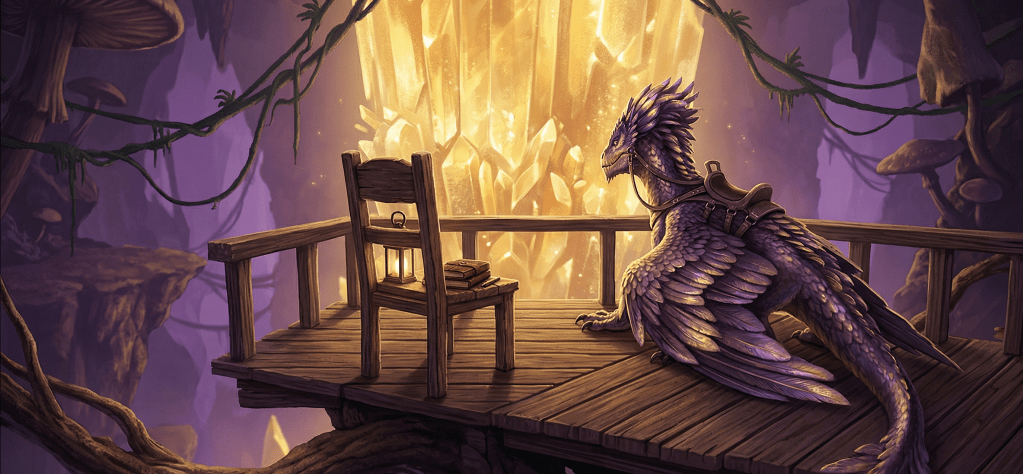
The overlook was a simple wooden platform thrust out over the void. It was his cathedral. It faced a massive wall of golden crystals that cast a steady, forgiving light across the abyss. To the man, these crystals were the only sun that mattered. They were an ancient, subterranean constant that never burned and never set.
He would sit in his chair for hours with his small stack of journals. Wayward would not pace or hunt during these times. He would drape his heavy tail across the man’s lap, a warm weight that anchored him to the present, and rest his head on the wooden railing of the platform. They sat together as two creatures of the dark, watching the one thing in the world that never lied.
One afternoon, a strange wanderlust overcame the man. It was a phantom itch from a previous life. Wayward seemed to sense the restlessness, nudging the man toward the saddle with a low, encouraging rumble. They traveled further than they had in years, away from the floating island and into the higher reaches of the cavern walls.
In a remote crevice, the man found it. A narrow path yielded a familiar scent that had been nearly lost at the edge of his memory. It was the sharp, clean smell of pine needles. He climbed off Wayward’s back, his legs shaking with the effort, and approached a jagged breach in the rock. It was a wound in the side of the world. Behind it sat the sky, a blinding, terrifying blue, so vast and open that it made his head swim. He stood there for a long time, the wind pulling at his thin, parchment-like skin. Wayward stayed still and silent behind him, staring at the opening as if sensing his friend’s apprehension.
The man looked at the sun. He thought of the rain and the trees with names carved into them. He thought of the world that had left him jagged. Then he looked back down into the dark. Wayward was waiting at the base of the trail, his unblinking eyes reflecting the man’s own silhouette. In that reflection, the man saw himself. He saw a man who was cared for. He saw a man who was loved by the very stone he had tried to hide within. He saw that he was no longer the broken shadow that had descended those years ago.
He did not hesitate. He mounted Wayward once more, and the two went back down to their home. They returned to the chair on the platform, facing the life-giving glow of the gold crystals. After a long while, he picked up his pen. His hand was steady even as his heart began its final, slow rhythm. He placed his final entry into a box on the mantle, tucked beside Wayward’s gear and the small, humming pod he had prepared to keep his friend safe.
“I finally found the way out. I could leave, But this is home now.”
He lowered himself into the chair on the overlook and faced the gold. He closed his eyes, listening to the steady, rhythmic breathing of the friend who had stayed when the rest of the world had abandoned him.
He was not a victim of the caves. He was the only man who had ever truly tamed them. He was not lost. He was exactly where he was meant to be.
He remained there until the end of his days, a silent watchman over a golden world. Wayward still roams the caverns today. He claims the floating island and his friend’s home as his own, a guardian of the log cabin and the stone hearth. He waits there in the purple and gold shadows, a legacy of the man who chose the dark, until another rider worthy or in need of his companionship finds their way into the heart of the golden light.

 Winged Dominion
Leave a comment