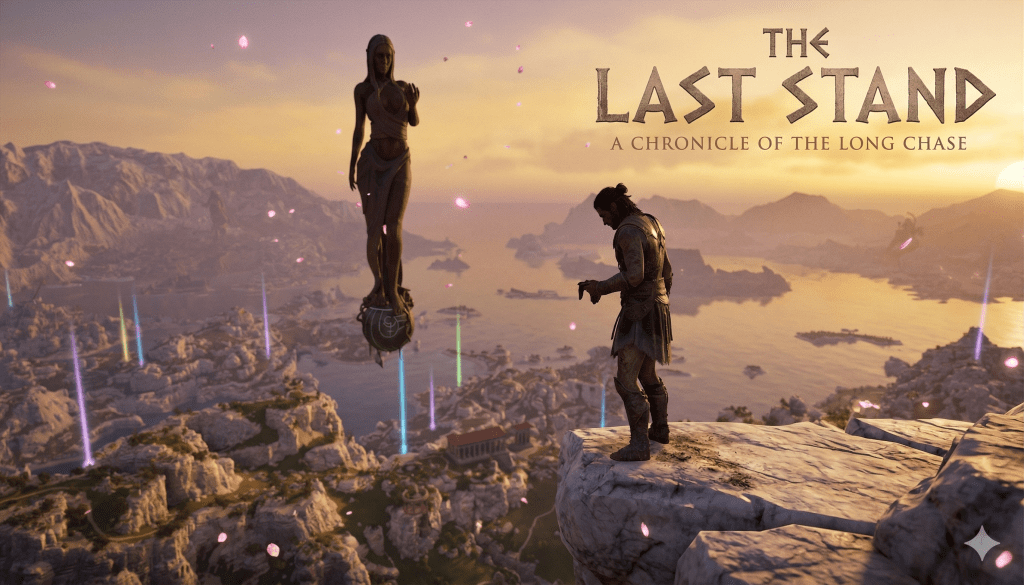
Chapter 1: The Ash in the Wind
Some men are born to the road, but others are driven onto it by the smell of woodsmoke and the sound of breaking glass.
For the man who would eventually be known only as the Wanderer, home was a word that had been incinerated when he was seven years old. He didn’t remember the names of the tribes or the complex geography of the Arks. He only remembered the night the orange glow replaced the stars. It hadn’t felt like a battle; it had felt like a clinical, terrifyingly quiet disappearance.
He remembered his mother’s hands: cold, trembling, and possessed by a frantic strength that bruised his small arms as she shoved him into the darkness of the root cellar. He remembered the heavy thud of the trapdoor closing and the frantic, rhythmic skritch of a heavy wool rug being pulled over the wood to hide the seams.
From the damp silence of the earth, he listened to the world end. He heard the roar of the thatch. He heard the heavy, wet thud of the front door being kicked off its hinges. But most of all, he remembered what he did not hear. There was no shouting. There were no pleas for mercy. Just the rhythmic, synchronized movement of feet on the floorboards above him: heavy, deliberate, and chillingly calm.
When the heat finally subsided, he pushed his way out into a grey, suffocating morning. He didn’t just walk out; he screamed. He ran from the charred skeleton of his house to the neighboring farmsteads, his voice cracking as he wailed the names of friends and playmates. He tore at the blackened timbers of the village meeting house until his fingernails bled, certain he would find them huddled beneath the debris. He needed the grim mercy of a body to bury.
But as he dug, the horror began to dawn on him, cold and silent.
The ash was too light. He sifted through the remains of the master bedroom, then the kitchen, then the porch, and found nothing but scorched wood and melted iron. There were no remains. No bone-ash. No scent of death. He moved to the edge of the clearing and saw his father’s heavy work-glove lying in the mud, thirty yards from the house. It wasn’t scorched. It lay near a set of tracks that didn’t belong to his people: deep, uniform indentations that marched in a straight line toward the dark treeline.
His father had taught him how to hunt small game. He knew the fire hadn’t been a weapon of destruction; it had been a distraction. A screen. A way to flush the burrow. The village wasn’t a tomb; it was an empty cage.
He sat in the center of the ash and wept until his throat was a raw, scorched wasteland. He packed a tattered, singed journal, a rusted skinning knife, and the few meager supplies he could scavenge from the ruins of his tribe’s life. He struck out alone, a spectre wandering a world of ghosts, driven by a question he was terrified to answer.
Twenty years of drifting followed. He became a scavenger of anomalies, a man who investigated every strange ruin or discarded note, hoping and fearing he might find a trace of those heavy, rhythmic feet.
He was twenty-seven when he reached the jagged peaks of the Astraeos range and witnessed the second ending of a world.
From the shadows of a cave, he watched a massive predator descend upon a nesting colony of mountain gliders. He watched the adults torn apart as they tried to defend the heights. Among the carnage, a single fledgling managed to scramble into a narrow crack in the rock. It was gravely injured, its dark, iridescent scales slick with blood.
The Wanderer stepped out of the shadows. His heart was rent asunder by the creature’s plight. It was a mutation of shadow: scales the color of an oil slick in a thunderstorm, rippling with bruised purples and blacks. He brought the shivering thing back to his camp and spent months nursing it.
As he sewed the creature’s shredded wing membranes with surgical patience, he spoke to it to keep the silence of the peaks at bay. One night, as the creature hissed in pain, the Wanderer looked at the jagged horizon.
“You don’t want to be here, do you?” he mused softly. “You’d rather be anywhere but this place. You’d rather be… elsewhere.”
The name stuck.
Years passed, the Wanderer and Elsewhere grew to rely on each other. Both of them spindly, but powerful things. Elsewhere grew large enough to carry a man, but only just. After much trial and error, and many near-fatal falls… the Wanderer fashioned a masterful rigging to distribute his weight across the creature’s slight frame, a web of leather that made them a single, precarious unit.
Even with the saddle’s near perfect weight distribution, when they lept from the cliffs together, the Wanderer knew he wasn’t just a rider; he was a burden. He could feel every frantic beat of Elsewhere’s heart against his own ribs. Every time the wings unfurled, the skritch of the membrane sounded exactly like a wool rug being dragged across floorboards.
For a few hours a day, at three thousand feet, they were the eyes in the sky. But as the years turned into two long decades, the truth settled in. He wasn’t outrunning the fire, and he was no closer to the truth. And Elsewhere’s dark scales were the proof that no matter how high you glide, you are always carrying the weight of what you’ve lost.
Chapter 2: The Face in the Iron Shell
If the peaks of Astraeos were a refuge of chaos and wind, the Temples of Korinthos were a map of rigid, terrifying order.
The Wanderer descended from the heights, the scales of Elsewhere shimmering like a bruise against the white marble. Below them, the temples rose out of the mist: colossal, bone-white structures that seemed to have been carved from the foundation of the world. They looked less like places of worship and more like monuments to a silence that had been carefully curated.
As they glided lower, the sky began to weep. Tiny, bioluminescent pink petals drifted down, swirling around the man and his beast. They settled on the leather rigging and Elsewhere’s wings, glowing softly in the twilight. They were delicate, fragile things: the opposite of the heavy, rhythmic terror he had spent forty years trying to name.
He brought Elsewhere down on a secluded terrace. He unbuckled the harness with hands that had learned to stay steady, though his pulse was a frantic hammer against his ribs. He hadn’t come to Korinthos for the view. He had come because of a rumor: a story of “the ones who walk without breath” seen moving among the white pillars. For the first time in decades, he had a lead. This excited, and terrified him.
The temple was hollow. The air inside tasted of ancient dust and the faint, lingering ozone that always seemed to follow the fire. He walked softly until he reached the Great Altar. There, resting in the center of the stone, was a scrap of parchment weighted down by a shard of black crystal. Where it came from, he didn’t know… but his source had been right.
The Wanderer picked it up. The handwriting was frantic, but legible.
“They come in the third watch. They do not speak. They do not run. They simply walk, and the world moves to accommodate them. I heard the sound before I saw them: the heavy, synchronized strike of boots on the stone. It is a sound with no heart behind it. If you hear the rhythm, don’t bother hiding, it is already too late.”
The not knowing that had lived in his marrow suddenly crystallized. He looked down at the floor of the temple. There, preserved in a layer of limestone dust, was a single footprint. It was uniform. It was deep. It was the exact shape he had seen in the mud outside his home twenty years ago.
The footprint was a compass, pointing the direction of answers that had haunted him since his childhood. He knew he had no choice but to follow.
The Wanderer tracked the indentations across the sun-bleached flats. They led with terrifying directness toward the Green Obelisk, a massive emerald pulse in the sky. It was crowned by a colossal, floating statue of a woman perched upon a glowing orb, her stone gaze fixed eternally on the horizon.
From the cover of a jagged rock, the Wanderer saw them.
There were six of them. They wore armor forged in a nightmare: matte black, covered in geometric spikes, and traced with thin, pulsing lines of glowing red energy. They didn’t speak. They stood in a perfect circle beneath the floating goddess. As the terminal reached its crescendo, the figures dematerialized, their forms breaking into shards of red light that were sucked upward into the orb.
The Eye in the Sky finally closed, and the boy from the cellar took over. He spurred Elsewhere into the light just as the terminal flared.
The world shattered and reformed into a sky the color of a fresh bruise. This was the Lost Colony. The massive city structure in the distance was far and again bigger than any of the stories could possibly describe. It was a world of suffocating gothic spires and mist that tasted of rot. He and the Maeguana spent weeks in the shadows, watching the Thralls, the mindless, silent workers who moved with that same heavy, heartless gait. Their faces were hidden behind iron visors that looked like cage bars. On numerous occasions he had to duck into the brush to avoid their gaze. Strange winged humans flew overhead, making the skies an unlikely escape route.
He found the link on a rain-slicked bridge. A group of Thralls had been intercepted by a gang of corrupted humanoids, twitching masses of obsidian flesh oozing a vile purple liquid. The clearing was a graveyard of black iron and broken spikes.
The Wanderer landed Elsewhere among the wreckage. The Maeguana hissed, his wings half-unfurling with that traumatic skritch, his eyes fixed on a single Thrall slumped against a pillar. The man was still alive, though the red glow in his armor was flickering out.
The Wanderer knelt. His hands shook as he reached for the Thrall’s helmet. With a sharp, metallic clack, the visor came free.
The Wanderer didn’t scream. He couldn’t even breathe. Staring back at him was a face he had memorized in the dark of a root cellar. It was older, the skin sallow and stretched tight, but the line of the jaw was unmistakable. It was his father.
But the eyes were the true horror. They weren’t the eyes of the man who had taught a boy to hunt. They were flat, milky orbs, devoid of any spark of recognition. There was no soul behind the glass. His father hadn’t been taken to be a prisoner; he had been hollowed out, his history scraped away to make room for the King’s red light. He had been made into a Thrall.
For a moment, on the very cusp of death, the dying man’s eyes cleared, widening in recognition, his lips moved, but no words came out: only a dry, mechanical rattle. The red lines on his chest dimmed one last time and went dark.
The Wanderer stood up slowly, the iron helmet falling from his numb fingers. He looked at Elsewhere, whose dark scales were now a flat, dead charcoal. They weren’t just orphans. They were the leftovers of a harvest that had never ended.
He looked up at the gothic spires and realized that there was no Elsewhere left to run to. The fire hadn’t just taken his home; it had taken the very possibility of a future. The fire in his heart went out, the last glowing embers of his childhood home.
Chapter 3: The Silence of the Stone
The problem with answers is that they rarely bring peace. They only bring the end of the question. These answers did more than end the question. They tragically ended the will to question.
For three more years after the rain-slicked bridge of the Lost Colony, the wanderer survived. He didn’t live; he simply persisted. Finding his father as a hollowed-out shell was a grief deeper than any grave. It was a trauma that froze the very soul, leaving no room for warmth.
A deep, dark depression settled into his marrow, a heavy orb of black ice in his chest, causing even the deep friendship of his companion to grow cold and distant. The Maeguana became a living reminder of the failure. Every time the creature’s wings unfurled with that leathery skritch, it no longer sounded like his mother’s rug. It sounded like the final rasping rattle of his father’s last breath.
Eventually, the Wanderer found himself back on Astraeos. He didn’t know why, other than the fact that the Green Obelisk was the last place he had been before the cruelty of his world turned him to a walking, breathing corpse. He sat near the console, staring despondantly up at the floating goddess perched upon her orb. Her stone gaze was indifferent, beautiful, and utterly still. He found himself trying to remember his mother’s face, wondering if she had shared that same noble bridge of the nose or the soft curve of the chin. He realized with a jolt of horror that he couldn’t remember. He had spent over forty years looking for her, and in the end, he had even lost the ghost of her memory.
He climbed the cliffs above the Temples of Korinthos. He didn’t fly to the top; he walked, one trudging step at a time, his boots heavy on the white marble. He found a ledge that looked out over the sea, a place where the pink bioluminescent petals fell from the sky like glowing tears. A vague memory of happiness washed over him as he recognized this spot as the very same where he had rescued Elsewhere and nursed the dying creature back to health. He built his final camp with a slow, mechanical precision. He fashioned a simple lean-to and laid out his sleeping bag. He built a small fire and watched it burn down to white ash: a tiny, final echo of the farmhouse fire. There would be no rebirth here today. Not for him.
He opened his iron chest for the final bureaucracy of a man who is well and truly finished.
He took off his Rigging, the work of art functioning as a saddle that had bound him to the wind. He laid his rifle, Fire Maw, across the leather. He counted his bullets. There were forty-seven. He had started with a full box of fifty when he reached the Colony. He hadn’t had to fire at a predator or a scavenger in three years, but three rounds were missing: one for each year since he had become a broken man, leaving one for each of the 47 years he had been alive. He didn’t remember firing them, or perhaps he had simply cast them into the void, one for every year he spent as a ghost.
Finally, he turned to Elsewhere.
The Wanderer held a cryopod in his shaking hands. The Maeguana looked at him with those large, dark eyes, as if it finally understood what its friend intended to do. For a fleeting second, the ice in the Wanderer’s chest cracked. A single, hot tear traced a path through the ash on his cheek. He leaned down, pressing his forehead against the creature’s cool, iridescent scales.
“I love you,” he whispered, the words barely audible over the wind. “Go to sleep, Elsewhere. The wind is tired.”
The pod opened, bathing the creature in a frost-blue light before finally hissing shut again. He placed the pod into the iron chest and clicked the lock. He felt a strange, hollow relief. He wasn’t a rider anymore. He wasn’t a burden. He was just a man on a cliff.
He sat on the edge of the ledge and shared a final meal of bread and a burning liquid that dulled the barest edges of his pain. He ripped a scrap of parchment from his old journal and wrote three lines. He didn’t write about the King. He didn’t write about the Thralls. He wrote about the only truth he had left:
“I followed the horizon far too long.
I think I’m done chasing it.
Look to Elsewhere.“
He stood up for the last time. He didn’t look back at the lean-to. He didn’t look back at the chest. With a silent prayer for his friend, his soul, and that of his lost family… he stepped off the white stone. Not with a spread of wings, but with the quiet dignity of a man finally reaching his front door.
He fell through the pink petals, past the white cliffs, and landed among the crystals below. He lay there, still and silent, as the bioluminescence of Astraeos began to reclaim him. He had finally reached the only horizon that never moves.

 Winged Dominion
Leave a comment