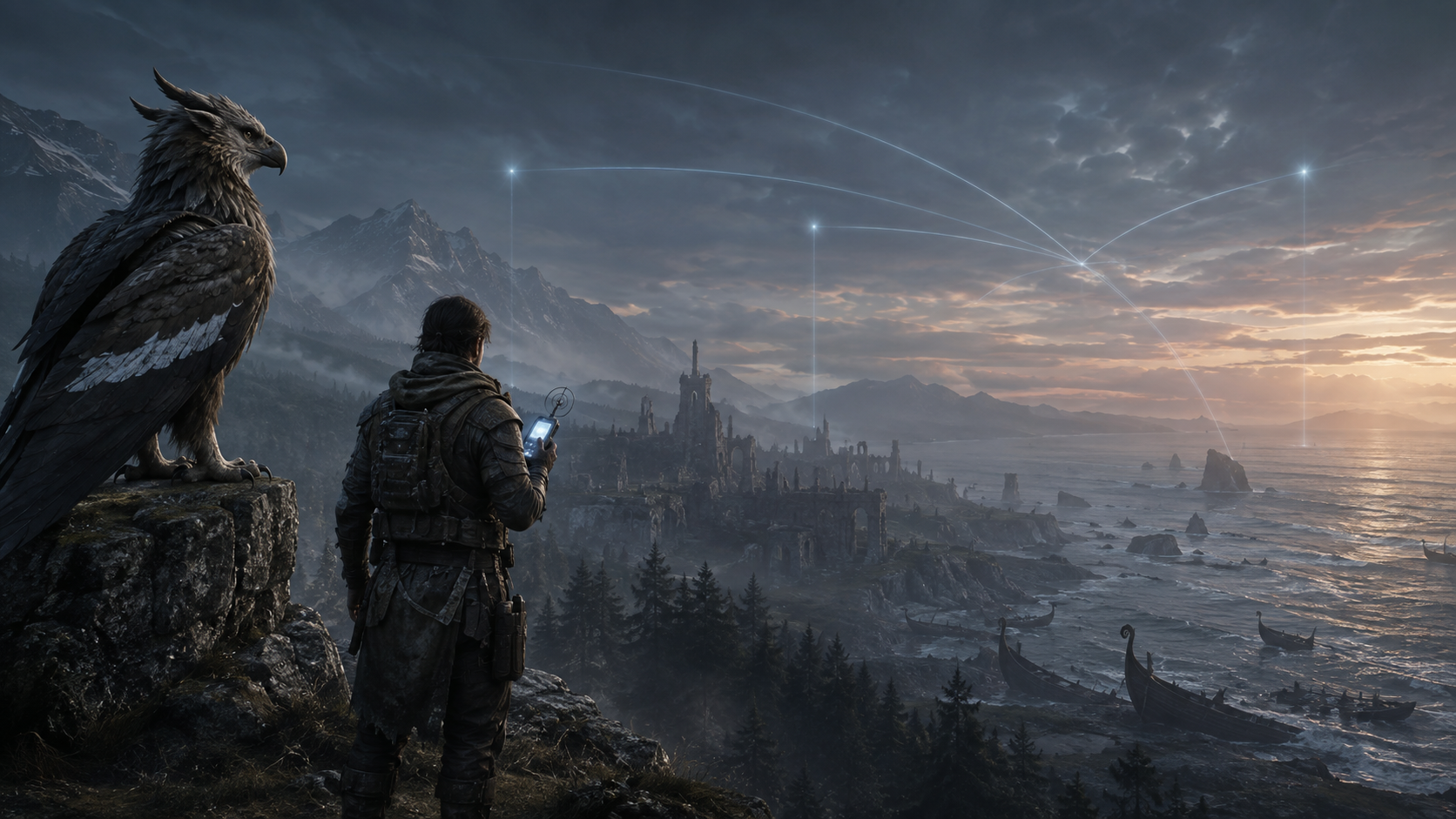
Recorded by Watch-Agent Arlen Vey
What follows is my complete field account of the anomaly we have come to call the Seventh Signal. I did not begin this investigation expecting to uncover a new path across the network. I began it because the infrastructure felt strained in a way I could not map, and I have learned through years with Talon Watch never to ignore the heavy, silent weight of things that cannot be seen until they are already upon you.
Chapter I: A Rhythm Beneath the Island
It began as a ghost in the network. Talon Watch picked up an anomalous audio pattern bleeding through the standard obelisk traffic, a faint and scattered frequency that refused to be cleanly isolated from the control room consoles. I have always believed that if you want to understand an anomaly, you must step away from the monitors and stand where the data actually flows. I traveled to the Island because its systems are old, stable, and documented down to the last weathered stone. It provided the only reliable baseline to identify outside interference.
I spent my first evening setting up field receivers near the Red Obelisk before moving along the damp, salt-scented western shoreline to test reception against varying terrain. The signal was frustratingly faint, threading through the ambient hum of the atmospheric regulators like a mechanical secondary heartbeat. When I finally ran the audio through my handheld decoder and adjusted the physical earpiece, I realized with a sudden, cold sense of unease that I was not listening to random atmospheric static.
I heard wind. Heavy, rushing gales. Beneath the wind, there was a low, measured, repeated impact that vibrated through the stones beneath my boots. Then came the voices. A single lead voice called out into the open air, rough and clear, and a much larger, synchronized chorus immediately answered it from the void.
As I adjusted my frequency filters to separate the tangled audio layers, I felt the distinct, prickly sensation of being watched. High on a ruined stone outcrop overlooking the dark surf sat a griffin. Every griffin I have ever documented across our existing Arks possessed the rounded, flat facial disc of an owl, evolution’s design for silent nocturnal hunting. This creature was entirely different. It bore the sharp, viciously curved beak of a high-altitude eagle, catching the faint starlight on its hooked edge.
When I packed my heavy equipment into my saddlebags and mounted my Argentavis to move to a higher reception site on the bluffs, the griffin followed. It kept its distance, floating on the updrafts with effortless authority, but it never lost sight of me. Eventually, it settled directly onto a coastal ledge where my instruments indicated the transmission was spiking in intensity. I spoke a simple calibration phrase into my receiver microphone to log the timestamp. For a fraction of a second, the ancient chant across my earpiece seemed to stutter and pause. The cadence shifted, dragging its rhythm as though something within the archival recording was actually reacting to the sound of my living voice.
It might have been coincidence, or perhaps just a degraded network loop reacting to unexpected local activity. But the more important discovery came when I finalized the geographic triangulation. All three of the Island’s primary obelisks were receiving the signal at nearly the exact same microsecond.
The transmission was not originating here. It was only passing through.
The signal had not led the creature to me. The creature had led me to the signal.
Chapter II: Wings Over Black Water
The trajectory derived from the Island’s data pointed straight toward Astraeos, and I took the transit portal expecting the signal to resolve itself into a localized glitch. I arrived as a violent, unnatural storm front was moving across the jagged coastline. I spent hours testing coastal ruins, sheer slate cliffs, and narrow island formations while freezing rain battered my heavy canvas oilskins and chilled me to the bone. Curiously, the transmission grew strongest over the open black water, where there was zero terrain to reflect, bounce, or amplify the sound waves.
I guided my Argentavis low over the churning swells, fighting the violent downdrafts that battered the bird’s broad wings and screamed against the leather rigging. Out of the driving gray rain, a shape materialized alongside us, keeping pace with our flight path. It was the eagle-beaked griffin. I recognized a distinct pale streak across the primary feathers of its left wing that marked it as the exact same individual I had encountered on the Island. It glided effortlessly beside us through the squall, unbothered by the turbulence, and banked sharply to lead me toward an isolated coastal ruin looming darkly against the white-capped ocean.
I set up my heavy receiver beneath a weathered stone archway, sheltering my notes from the spray, and fed the raw signal into my isolation filters. I was finally able to peel back the acoustic layers of the recording. There was the single caller and the responding chorus. There was the heavy, rhythmic beat keeping absolute time. And underneath it all, cutting through the static, I heard the violent, wood-splintering creak of strained timber and the unmistakable, rhythmic rush of heavy water moving beneath the singing men.
I sat on a damp block of ancient masonry and listened to it loop for nearly an hour. The sound was not random noise, nor was it a glitch in the translation matrix. The voices were intentionally keeping time together.
Whatever waited beyond the signal was not calling blindly into the dark. It was keeping time.
Chapter III: Fire in the Scar
By the time I rerouted my trajectory toward Valguero, the data had stopped being just an audio file. The architecture of the local grid was beginning to fracture under the strain of the incoming transmission.
I followed the resonance spike directly into the heart of the Wyvern Scar, podding my Argentavis and trekking down a narrow, treacherous switchback on foot where the air grew thick with sulfur and ash. The heat rising from the volcanic fissures was oppressive. Dodging the scar’s inhabitants is usually a daunting task, but the chanting in my receiver was deafening, bouncing violently between the towering, soot-stained obsidian cliffs. It seemed to confused the creatures, dampening their normal extremely hostile nature and leaving them almost listless. The audio data was now heavily laced with the sound of cracking stone, superheated pressure release, and a deep, furnace-like intake of air that felt like a massive lung drawing breath. The unstable connection was tearing environmental fragments from the void and forcing them directly into Valguero’s grid.
I looked up through the rising sulfur smoke. The eagle-beaked griffin was circling high above the trench, caught in the thermal updrafts. For the first time, it appeared hesitant, perhaps even unwilling to approach the focal point below. It shrieked, a sharp sound cutting over the roar of the magma, and banked hard away from the reception site.
Deep within the canyon floor, the molten rock began to coil and twist. It was not a natural eruption. The lava fused together in unnatural geometric patterns, rising into a towering, terrifying shape of liquid fire and jagged black obsidian. A massive Lava Elemental had manifested right over the strongest point of the signal reception.
The creature was a colossal guardian born directly from corrupted, high-energy transfer data. I could not safely approach the receiver array or extract the local telemetry while that thing remained standing in the trench.
I keyed my communicator, opening a high-priority channel to the Dominion’s guard forces stationed in the encampments above.
I have located the source.
I cannot reach it while that thing remains standing.
Chapter IV: The Ruins Keep Time
Extinction
The Dominion forces brought down the elemental after a brutal engagement in the heat of the Scar, and from the cooling slag, I recovered a dense, hardened fragment of compressed data and material. I packed it carefully into my saddlebag and flew straight to the dead city of Sanctuary on Extinction, using its massive, abandoned infrastructure as a makeshift laboratory to run my diagnostic suites.
As I walked through the silent metallic canyons of Sanctuary, pulling my woolen cloak tight against the artificial chill, the dead terminals around me began to flicker to life on their own. Corrupted relays activated in sequential bursts. The soft, ghostly lights of the ruined streets pulsed in exact, hypnotic rhythm with the chant playing through my deck. The visual effect was deeply unsettling, creating the illusion that an invisible host was marching through the empty boulevards, keeping perfect pace with the impacts in my ears.
I found the griffin perched motionless at the base of a shattered tower, watching the pulsing streetlights. When I approached, I noticed deep, heavily oxidized gouges in the metal plating beneath its talons. Those marks were centuries old, suggesting these creatures had been slipping through the cracks of our world long before Talon Watch ever detected a whisper of the signal.
I connected my data slate directly to the tower’s central terminal, leveraging the city’s dormant processing power to analyze the fragment from Valguero. The terminal took hours to unpack the material signatures, but when the results finally rendered, they defied every law of ARK ecology. The fragment contained an impossible blend of volcanic basalt, glacial ice-core sediment, deep ocean floor silt, ancient forest organic matter, and weathered wood fibers treated with primitive ship resins. All of it bound together from a single, unified origin point.
I turned back to the console and overlaid the reception coordinates from the Island, Astraeos, Valguero, and Extinction. The map did not form a linear path. It formed a closed ring. The known Arks were not competing reception sites; each one was holding a separate piece of a massive, distributed handshake protocol.
The final missing component of the ring pointed directly toward the frozen vaults of the Genesis 1 simulation.
Chapter V: Beneath the White Crown
Genesis 1
I took the combined telemetry into the Genesis 1 ice biome, wrapping heavy furs over my leather gear and leading my Argentavis across the frozen plateaus. The freezing wind battered my face, but inside my helmet, the chanting was crystal clear, stripping away the last layers of static.
I found a protected hollow beneath a massive blue-ice overhang and lit a small, chemical camp heater to keep my fingers from stiffening. On the ridge above, the familiar griffin waited against the driving snow. But it was no longer alone. Through the swirling whiteout, I caught the unmistakable silhouettes of several other eagle-beaked griffins moving together across the glacier, proving beyond a doubt that my recurring guide was part of a larger, migrating population seeking their lost home.
The sixth and final receiver point lay buried deep beneath the frozen crust of the lake below. Just as in Valguero, the ancient signal began pulling from the localized data reserves to build a physical defense. The ice fractured with a sound like rolling thunder, and a towering, high-level Ice Queen erupted from the frozen ground. She moved with the cold, unyielding grace of a programmed sentinel guarding the final lock of a vault.
I activated my beacon and called for the Dominion vanguard once more.
When the freezing battlefield finally fell quiet and the sentinel was dismantled, I dropped down to the shattered ice pit and accessed the final receiver node. I slotted the combined telemetry drive into the console. The terminal locked. The six points of the ring aligned into a single, cohesive frequency.
The chant in my earpiece swelled to a magnificent, roaring crescendo of thousands of unified voices—
And then it stopped.
There was no fade. No final cry. No lingering echo of metal on wood. There was only absolute, ringing silence. My console flashed a solid, stable green. A seventh destination blinked into existence across the cluster network.
On the ridge above, the griffins turned their heads toward the new vector. In unison, they launched themselves into the freezing air, flying directly toward the newly opened transfer corridor.
Chapter Epilogue: What Remains
Ragnarok
I crossed the transfer threshold into Ragnarok expecting the chanting to return at deafening volume, expecting to step directly into the roaring heart of an ancient encampment.
I materialized on a quiet coastal shingle, my hand instinctively resting on the grip of my sidearm.
There was nothing.
The new world was entirely, profoundly silent. There were no watchfires burning along the cliffs. No armored host waited on the shore. No living voices answered the sweep of the wind through the pines. I lowered my hand, standing completely still to listen. All I heard was the steady wash of water against the rocks, the rustle of leaves in the deep forests, and the distant calls of native wildlife.
High above, the familiar griffin soared through the clean, open sky of the highlands. It did not look back. It did not circle or wait. It simply banked toward the interior mountains and vanished into the timber, finally home.
I walked inland, tracing the curve of the shoreline until I found the physical truth of the world. Half-buried in the sand and salt grass were the massive, collapsed wooden hulls of ancient longships. As I pushed deeper into the tree line, I found stone settlements long since reclaimed by moss and creeping roots. I found cold, ash-choked fire pits and weathered wooden shields splintered and rotting into the soil.
I knelt beside one of the broken shields, brushing the dark earth from its corroded iron rim, and shifted the edge against a stone. It struck with a heavy, hollow clack.
My wrist receiver instantly lit up, capturing the acoustic signature. It was an exact match to the rhythmic impact buried deep beneath the recorded chant.
I stood slowly, looking out over the silent, sweeping landscape. The transmission had not described Ragnarok as it is today. It had remembered Ragnarok as it was.
The people who had sung those songs, who had rowed those ships and built those halls, were long gone. Their names had vanished from every database, their fires had gone out ages ago, and their civilization had dissolved into myth. The Ark’s ancient automated systems had simply preserved their voices in a broken beacon, echoing their final hours long after there was anyone left to hear them.
The silence was heavier than the song had ever been. But as I looked back toward the obelisk, watching the cluster network pulse with steady, unyielding light, I knew our work here was finished. The ghosts had finally found their quiet.
The way is open.

Leave a Reply